artistic vision, book review, communication, entertainment, family, reading, theater

“To Whom it May Inspire.” Thoughts from Creativity, Inc.

I am really jealous of my oldest daughter in one specific way. She seems to be able to make time to read…like really read maybe for an hour or hours a week. I’m not sure how she does it, but thinking back….there was a period of time in my life when I did the same thing. I’m desperately trying to regain that desire/ability, but still struggling a little.

A couple of year’s ago my daughter, Becca author of the Blog, Daily Joy, read the book Creativity, Inc. by Ed Catmull. She told me that I really NEEDED to read the book. To be honest, I kinda blew it off. Why did I want to read a book about the President of Pixar?? My mindset was that Pixar wasn’t Disney and I was too old for cartoons. So, when my daughter, Ashley, gave me the book for Christmas, I put it away.

Enter Covid. (Is it strange that every one of my blog posts lately say…Enter Covid? Life changing for sure….)

With Covid my world stopped and I tried to recreate good habits and get rid of old bad ones. I had previously made a New Year’s Resolution to read at least one book a month during this year. After a few light reads I decided to pull this book off the shelf.

Creativity, Inc.: Overcoming the Unseen Forces That Stand in the Way of True Inspiration by Ed Catmull, co-founder (with Steve Jobs and John Lasseter) of Pixar Animation Studios, the Academy Award–winning studio behind Inside Out and Toy Story.

I cannot believe I waited this long to read this book. It was inspirational, motivational, entertaining and educational. This book tells the story of a man who had a dream and worked hard to build a company that set a new standard for a creative culture–believing at all times–that it is important to do the best work possible. I started reading it thinking that it was a great book to tell the story of Pixar, but quickly began telling my friends and anyone who would listen about the lessons I learned each day.Lessons that applied to me as a writer, director, story-teller, leader, President of a non-profit and maybe even just a person. I started taking notes realizing that this book is for me. Ed would tell stories about how they would write their scripts and I would find myself realizing that his struggles were things I needed to learn from.

My lessons didn’t stop there because Creativity, Inc. is also a book for managers who want to lead their employees to new heights, and create a working environment that is successful, safe and causes each employee to also strive to be better.

Here are a few of my favorite quotes:

“If you give a good idea to a mediocre team, they will screw it up. If you give a mediocre idea to a brilliant team, they will either fix it or throw it away and come up with something better.” 

“You are not your idea, and if you identify too closely with your ideas, you will take offense when they are challenged.” 

“Failure isn’t a necessary evil. In fact, it isn’t evil at all. It is a necessary consequence of doing something new.” 

“If you aren’t experiencing failure, then you are making a far worse mistake: You are being driven by the desire to avoid it.” 

“Getting the right people and the right chemistry is more important than getting the right idea.” 

“When it comes to creative inspiration, job titles and hierarchy are meaningless.” 

“When faced with a challenge, get smarter.” 

“Fear can be created quickly; trust can’t.” 

“Craft is what we are expected to know; art is the unexpected use of our craft.” 

“Making the process better, easier, and cheaper is an important aspiration, something we continually work on—but it is not the goal. Making something great is the goal.” 

“What is the point of hiring smart people, we asked, if you don’t empower them to fix what’s broken?” 

“Always take a chance on better, even if it seems threatening.” 

“You’ll never stumble upon the unexpected if you stick only to the familiar.” 

“Be patient. Be authentic. And be consistent. The trust will come.” 

“The future is not a destination – it is a direction.” 

“We must remember that failure gives us chances to grow, and we ignore those chances at our own peril.” 

“We want people to feel like they can take steps to solve problems without asking permission.” 

“THERE IS NOTHING quite like ignorance combined with a driving need to succeed to force rapid learning.” 

“Quality is the best business plan.” 

“it is not the manager’s job to prevent risks. It is the manager’s job to make it safe to take them.”

The title, “To Whom it May Inspire.” is taken from a section of the book where Ed is talking about something he created called, “Notes Day.” He warns that things change and that they should and we shouldn’t be afraid of that change but instead approach it with fresh thinking. Ed received a letter from one of his animators, Austin Madison, which started, “To Whom it May Inspire,” He stated that like most artists he constantly shifts between two states. The first is white-hot, “in the zone.” A place where everything flows creatively. He says it only happened 3% of the time. The other happens the other 97% of the time and is when we are frustrated, struggling and throwing ideas out the window constantly. His advice?

PERSIST

PERSIST on telling your story.

PERSIST on reaching your audience.

PESIST on staying true to your vision.

That’s what we do. Keep on keeping on. Stay focused. Don’t give in.

I think there is comfort in the fact that we will always have problems: some we see right away and some that come out of nowhere….like COVID.

It isn’t the goal to avoid the problems or even to make things easier. The goal is to rise above the problem with excellence.

Who is this book for? EVERYONE. Honestly, do yourself a favor and read it. It isn’t a quick read because there is sooooo much to think about. You might be surprised. You might even shed a tear. It’s that good.

Link to the book on Amazon – https://www.amazon.com/Creativity-Inc-Overcoming-Unseen-Inspiration/dp/0812993012/

I’d love to hear your thoughts! Thank you in advance for commenting and for sharing this post!

Until next time,

audience, broadway, christian, christian blog, entertainment, intermission, planning, ten commandments, theater

The Long Intermission

Since the election the cases of the virus have gone down in Illinois dramatically. The vaccines have begun with many people all ready receiving their second shot.

As artistic director it is my responsibility to plan the season of shows. I am still plagued with doubts. What about the new strains? Is this temporary? Even if everything opens back up will my audience feel comfortable sitting shoulder to shoulder? If not, how long will that take?

In light of that…I’m reposting.

I was in sixth grade when I saw my first stage production. It was a high school production, but that didn’t make it any less remarkable for me. I loved the story, actors, music and dancing. In fact, I loved the whole evening. I think I’m a little unusual in that I seriously enjoy EVERYTHING. I love the energy of the audience as they anticipate the show and seeing their friends or family on stage. I love combing over the playbill and reading the bios and even the advertisements! Then, the orchestra begins to tune their instruments! For most people that isn’t remarkable, but I love listening as they play a note, adjust the string or reed, and play again and again until the whole orchestra can play a note with a unified sound. The curtain goes up and the magic continues. Until intermission….

Intermission:

a short interval between the acts of a play or parts of a public performance, usually a period of approximately 10 or 15 minutes, allowing the performers and audience a rest.

a period during which action temporarily ceases; an interval between periods of action or activity:

Legend has it that in the late Middle Ages early renaissance (in theatrical terms at least think 16th 17th centuries ), theatre began to move from performances outdoors to indoor facilities. Theaters used candles to light the house and the stage. Intermissions began because the candles needed to be changed. While the candles were being changed, vendors would come and sell to the audience members to keep them from leaving the theatre.

Most productions that are longer than 90 minutes will have an intermission (even though the need for changing candles has long gone.) And indeed, it does provide a wonderful time for the audience to stretch their legs, go to the restrooms and browse the gift area or buy concessions. I’m used to the way that process works around this area, but imagine my surprise when I attended New York theaters years ago and they ushered us outdoors and to the restaurant close by to use the restroom because there simply was not time for the whole audience to use the facilities that were located inside that theater! It was a new world!

Does the intermission still have value in today’s world? Here are a few reasons I think it is necessary.

  1. An intermission builds anticipation for what is to come. It gives the audience a chance to stretch, move around, get a drink. And socialize. Which I believe is a very real part of the theater experience.
  2. An intermission allows the actors time to rest or change costumes or grab a much needed drink of water.
  3. An intermission allows the crew time to change the set for the next act.
  4. I try to not have a bottom line that is all about money, but let’s be real…concession sales are a part of a theater’s budget so in that regard, an intermission is very necessary.
  5. In productions that have employed musicians, union rules need to be followed, so that in most cases breaks need to be provided for the orchestra members.

That’s intermission in a world that ceased to exist weeks ago. And we don’t know when or if it will ever return. Thus, we have entered an intermission of sorts. I was listening to a short message from Bob Bixby (friend and Pastor in California. You can reach him at bobbixby.wordpress.com) when this first started and he mentioned that the Lord had given us a Sabbath. I have been fascinated by that thought since then. Did you know that one definition of the word Sabbath is intermission?? An interlude, a pause before we move into our next phase of work.

I didn’t.

What do we know about the Sabbath?

God included it in the Ten Commandments. It wasn’t a suggestion. It was a commandment.

God wants us to receive something from this time of rest each week.

  1. It should be a time of resting from our work. It is a day that gives us a chance to renew ourselves physically, emotionally and spiritually.
  2. This is a time that we can spend quality time with God, but also have fellowship with your church family and others that we love. If we set this day apart we can create close relationships with others that can be spiritually rewarding as we encourage each other and grow together.
  3. This is a time we can stop and think about the blessings that God has given us. Sad to say that sometimes we get so busy with our day to day lives that the act of thankfulness is a trite thought in our prayers, but with a day set aside to reflect on the mercies of God, we can cultivate a attitude that should carry us through the week.
  4. This is a time set apart to rejoice and worship.

The day. The command. It is a gift.

I’m not going to lie. This time of shelter in place has been difficult for me. The theater being shut down has been painful for me. But could it be that in some ways it is a gift from God? A Sabbath? A pause. A time to reflect and regroup and thank God for His mercies which are new each morning.

Jesus said, “Come to me, all of you who are weary and carry heavy burdens, and I will give you rest. Take my yoke upon you. Let me teach you, because I am humble and gentle at heart, and you will find rest for your souls. For my yoke is easy to bear, and the burden I give you is light.”
Matthew 11:28-30

Dear God,

I didn’t want to slow down, but I have loved what you have taught me during this time. Help me to be thankful for each day. Help me to learn from this time of intermission. Bring the rest for my soul. Thank you for the blessings that you have brought during this time and the mercy you have shown. Thank you, for understanding my burden. Thank you for the gift of Sabbath.

I would love to hear your thoughts on this subject! And as always, I’d love it if you would take the time to share this blog!

Until next time!

Reba

acting, awards, critics, entertainment, family, oscars, theater

Meet Guest Blogger-Jarmila V. Del Boccio,


CAN YOU HEAR THE PEOPLE SING?

I DREAMED A DREAM THAT THEY WON ALL!

AM I ON MY OWN IN THIS?

https://www.amazon.com/Miserables-Hugh-Jackman/dp/B00KKNMGRC

LES MIS SHOULD HAVE WON MORE OSCAR AWARDS!


At first, I was discontented. Well, okay, miserable. Only three awards out of eight possible? C’mon! Couldn’t the judges see the talent, energy, and pathos that went into the production?

Although I don’t usually watch the Oscars, I was curious to see how my favorite film of the year fared against the others.

Best supporting actress? Of course!

Best sound mixing? I agreed.

Best Makeup and Hairstyling? I saw that, too.


But, I wanted them to win all the awards. Then I settled down and realized there are other deserving actors/actresses, especially from other cultures who need a win as well.


Then, I got to thinking about our performance as Christians on the stage of life. Are we winning heavenly awards that will bring glory to God and not ourselves?


For instance (and I’m questioning myself) . . .


Best Leading Actor: Are men taking their roles as leaders seriously? How about church leaders? Or anyone for that matter, in a leading role?

Best Supporting Actress: Are you as a wife taking your God-given role seriously and supporting your man? Or, if you are a young person at home, are you supporting your parents? How about singles? Are you being a good friend, and honoring your boss (no matter what gender you are)? How about pitching in with the gifts God has given you in your local church? Congregations, are you bringing joy and not pain to your church leaders?

Directing: Let’s turn the tables — are you allowing God to direct your life, or are you taking charge?

Best Costume Design: Are you “putting off” the dirty garment of anger, lies, and filthy talk? And “putting on” the fresh, clean garment of kindness, humility and patience? (Colossians 3:3-14) Or, possibly, are you pretending to be someone you are not?

Best musical score: Is your life a symphony of comforting notes and scores that brings joy to those around you?

Visual effects — Does your countenance reflect your heart? Do your deeds reflect your relationship with the Creator?

Writing: Those of us who are authors, are we writing for the glory of God, or for a spot in the limelight?

Sound Editing: How is your tongue? Are you silencing those harsh or untrue words before they hurt others?

Cinematography: if you were to play your life back on the screen in a two-hour movie, how would the audience react at the end? Give it 5-stars? Cry at the tragedies that led to more tragedies without meaning? Laugh uproariously because its so true in your own life, a mirror that reflects your need to change?

I’d love to hear your ideas below in the comments!

So, I leave you with the musical performance of Les Misérables cast at the 2013 Oscars…now that deserved an award of its own! You can find the performance at 1:18

Of course, only God deserves our ultimate praise and worship, but, as we do our best in our work and life, we reflect God’s excellence:

“Praise him (God) for his mighty acts: praise him according to his excellent greatness.” Psalms 150: 2

Jarmila’s historical fiction The Heart Changer 💗 released April 26th.
Find it here: https://amzn.to/2SCcPnx

Author’s website ✍🏻: https://www.jarmdelboccio.com/


acting, artistic vision, characterizations, entertainment, family, intern, reading, theater, theater education

Meet Guest Blogger–Kady Debalak

This quarantine has provided me with some rare opportunities as I’m sure it has to you. (Positive thinking, people!) Maybe you found time to finally deep clean the garage or that closet? Or…just to sleep! I’ve found time for two of my favorite things: cooking and reading (make that 3 – eating – let’s be real). In addition to my favorite genres, history and fiction, I’ve been reading more plays (and eating more…and…riding my bike more – gotta combat the COVID 20!…Pounds that is).

I´ve been thinking about how I would stage and develop these plays (I have a few shelf fulls I´ve been working my way through). In thinking (and eating, of course) during all of this, I discovered the topic for this blog!


Cooking up Characters with Kady!
(did you like that alliteration?)
Seriously though, there are so many parallels between cooking and directing that once I started, I just couldn’t stop seeing the similarities. So, here are some ´tasty´ thoughts about how to ´cook´ up and serve characters and actually, the whole show, as a director.

First, and absolutely the most essential, is the visualization. I have always been fascinated with the process of taking raw ingredients and reshaping them into a new cohesive whole, which is why I love cooking. (plus I love eating, gotta be real folks). Taking ´raw´ ideas and reshaping them into living breathing characters in a ´real´ world is why I love directing. Both cooking and directing spring from visualizing the final product.


Michael Kum leads the students in an acting exercise during the creative process for “The Hobbit.”

An important caveat: I make no claims to be a professional or even a remotely good cook! (and definitely not baking – I have not conquered the opera cake yet – plus I haven’t deboned a duck…let alone a chicken) And I am most definitely not a Broadway director. I direct summer camps for Overshadowed and direct my school´s drama program/plays. Broadway someday? I can dream. But in the meantime, I absolutely L-O-V-E what I do. So back to it.

I almost (not completely because I l-o-v-e to eat) enjoy imagining the combination of flavors, texture, and plating more than creating the actual dish. Why? It’s the wonder of possibilities! It’s the magic of ´before´ reality hits and all the obstacles jump up to bonk you in the nose. As I read a script, the same thing happens. Oh the possibilities! I imagine the world with the movie or I should say, the ´stage of the mind´. And while the show plays, I ask questions: What do I think the forest of Oberon and Titania actually looks like? Should the 39 Steps be staged as a radio drama or can it be ´live action´? And Jane Eyre..modern or historical? How should Don John hide his perfidy from the characters but not the audience in Much Ado About Nothing? How would an audience react to a production of Raisin in the Sun? How actually should I create the creatures of The Hobbit? (that one was answered brilliantly by my creative team!)


Sometimes the visualization doesn’t start with a script. It sometimes happens like my grocery shopping (especially when I´m hungry). Sometimes, I will see a unique ingredient (like a kumquat) and think, ´I´ve never cooked with that before. I wonder how it can be used and what other ingredients will go with it?´ Then, I pull out my phone right there and look up ideas, nutritional facts, and common or unique ways to cook it. And then into the cart it goes and the adventure begins! Sometimes I´m introduced to a new idea I´ve never used before, or a story I´ve never heard of, or a design element or tool I’d absolutely love to use. The research begins and ´Oh the possibilities´!

And once the mind, and sometimes the heart, are full of all the possibilities, I have found I need a lot of help to make that dream a reality.

Which of course leads to the next step: the collaboration.

With the ´recipe´ of the visualization in hand, I turn to my team. As a director or the visionary of any creative endeavor, this is the most essential task – getting your vision, ideas, tastes, textures, mood, hopes, fears, wish lists, and the world across to your creative team.

Not just so they understand what is being created, but so that they catch your hunger; so that they take ownership of the vision as well. Any chef knows the explanation of a recipe must be absolutely clear or what will be presented to the diner will be a muddied catastrophe. The director must be absolutely clear in establishing the framework and details the world his/her team is to work within. They become your sous chefs in their respective areas of expertise. Lighting, costuming, makeup/hair, sound, house, set, props, stage crew, marketing – you name it. This utterly essential team must hunger for exactly what you´re hungering for. If you pick well, as I have thankfully often experienced, they will love your vision as much as you do. And as such, will willingly share in the burden of creation.

The creative team is not just there to share in the burden, they´re there to add to the dish. Having other’s input adds flavor, shape, and foresight or resolution to problems you couldn’t see (I tend to dream big, my team helps keep my feet on the ground). Plus, someone else’s creativity and skill can make all the difference. That doesn’t mean the recipe loses its intrinsic value, its central identity, or that the director loses ownership. It simply means a new perspective of costuming, some expertise on how to actually make those puppets work, a composition of the mood you wanted to convey through music, or a unique way of enhancing audience interaction will all help create an authentic performance. That is simply invaluable. This team will become your fellow visionaries, and in some cases, dear friends with whom you can share and bolster the creative process through all the possibilities.

The third step (which I adore) is the preparation, or the creation of the characters. This is the step of pulling the characters from the page into the world that has been envisioned and is being created. This step requires reliance on the sous chefs/line cooks.

I think actors generally fall in the range of both. (I speak as an actor as well). What I mean is this:
My niece is 14, precocious, opinionated, very chatty, beautiful, creative, and did I mention opinionated? My nephew is 16, tall, handsome, a sweetheart, intelligent (single) and follows instructions well. (I love them…clearly) When my sister and I cook or bake (Which we love to do! She could open her own restaurant), we do enjoy making it a family affair, which means pulling my niece or nephew into the adventure. Both enjoy cooking in my sisters kitchen, but one is a sous chef and one is more of a line cook. My nephew takes the instructions and performs with minimal questions. Need something diced? Grilled? He’s on it. If he doesn’t know how, a demonstration or explanation is given and he’s good. My niece, on the other hand, needs to know why. Always. ´Why not julienned instead of diced? It will look prettier, Aunt Kady!´ Oy vey! I have learned that after explanation, and after she has defended her point of view (vociferously), I have a choice. I can modify per her suggestion, or if that modification takes us outside the parameters of the recipe, I can choose not to. But I had better clearly explain why not to her before she is willing to move on. And she does, and dices with absolute precision. She does so because she owns her understanding of why. It’s now her mission, her task, her recipe too. Now I know sous chefs are second in command in the kitchen. I´m not saying actors are assistant directors. But, when it comes to character creation, the directorial vision has to be handed over to the ´assistant´ creators of those characters – which is the actors.


I have found that despite training (Meisner, Method, College degree, or complete amateur), actors generally land somewhere between my neice or my nephew. I enjoy both the line cooks and the sous chefs. Those like my nephew take the instruction and go with it. If they need direction they ask or accept it, then take it and go. They have already signed up to your vision because they trust it’s gonna ´taste´ good (especially if it’s pasta). They really thrive when the director is ´hands on´ in the early stages of laying out the elements of the character that he/she want to see brought to life and then stepping back and allowing the actor to take on the responsibility progressively throughout the entire process until of course they present the character on stage before an audience. Others…well…are my niece. They may question your vision from the very start. It doesn’t matter if they are highly trained or complete newbies. These are more sous chefs than line chefs and need to own the ´recipe´ of their characters as their own. This means you have to explain the vision and it needs to make sense to them. They need to understand the world their character lives in. And if it doesn’t make sense and they just can’t claim ownership of it, well… there have been times I’ve kicked my niece out of the kitchen. But when they do own the vision, when they are allowed to add their flavor to it… the performance that results from such an intensive shaping can be so enriched and authentic. In the world that’s been created by a team fully committed to the vision, adding a performance that has been relentlessly picked apart, lovelingly shaped together, and executed with absolute belief is utterly glorious! I guarantee that your audience won’t soon forget it. It is a beautiful preparation.

From visualization to collaboration to preparation, we’ve arrived at the final flourish, the lifting of the silver dome – the presentation! What a wonder it is when that curtain finally rises! A chef can indeed cook alone and create an adventure on a plate that the diner won’t soon forget.

But theater is not a solo endeavor.

Besides creativity and teamwork, its most important ingredient is trust. The playwright must trust that their story will be told with integrity, even with creative license. The director must trust that the world he/she envisioned will truly be brought to life by the design team, the crew, and the actors. And when the audience sits down to dine on the feast that is truly the ´theater experience´, they trust that the performance they are about to partake in has been cooked up with the greatest love, professionalism, care, detail, and creativity, with a dash of magic. Bon appetit!

ou can contact Kady at kdebelak@gmail.com

We would love to hear what you think about the creative process. Please take time to share this blog!

Until next time!

anne frank, audience, broadway, entertainment, family, shrek, theater

Ten Lessons About Social Distancing and Times of Crisis That We Can learn From Theater

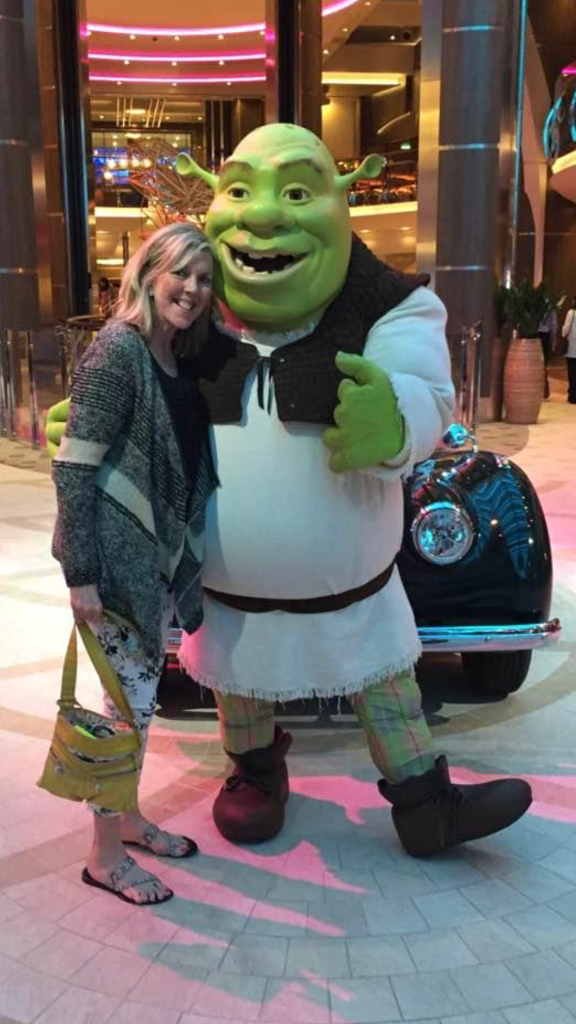
I had the chance to meet “Shrek” and loved it when he said I was just a big kid! Don’t judge!

  1. Shrek is the perfect example of social distancing. When he is misunderstood, he decides it is better to live alone and in the swamp. Of course, he meets Donkey and Fiona and well..who can resist a good love story reminding us that we are better with people. The other favorite about this musical is

that it ends with a Monkee’s song, Daydream Believer. I loved the group and this is one of my favorite songs so getting to enjoy that song at the end of this musical makes it a real treat.

2.  Les Misérables. I think I can speak confidently for broken-hearted girls everywhere that Eponine is their representative. She has a horrible home life and has really had to take care of herself most of her life. Then she meets, Marius, basically someone that could be her prince charming. Is it love at first sight? Nope, not for this tragic creature. Instead she helps him communicate with the person he has fallen in love with. She sings the song that many a girl has belted out in their rooms through tears. “On my Own.”

On my own
Pretending he’s beside me
All alone
I walk with him till morning
Without him
I feel his arms around me
And when I lose my way I close my eyes
And he has found me

Yep. That’s what we are all doing right now. All alone. Maybe the lesson we learn from her is that we can sing our way through any circumstance in life!

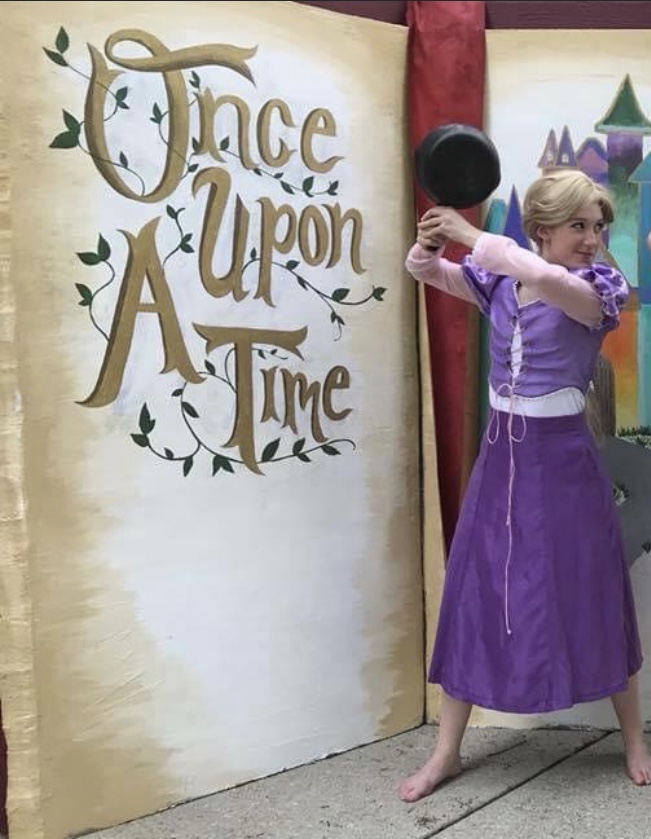
3. Rapunzel. This sweet character was locked away in a tower for most of her life. I mean, you all remember how long her hair was when her prince climbed up to rescue her, right? (And you think you need a hair cut…) One of the main things I love about Rapunzel is that she made good use of her time. She painted and baked and well…everything. What new skill are you learning as you are confined?

Brianna Valentine played Rapunzel for our Movie in the Park event. I am so sorry you can’t see her beautiful long hair in this photo! Especially since it represents how badly we all are going to be in need of a hair cut when we get out again!

Oh, by the way. This story also teaches us about hope. Rapunzel’s parents never gave up hope that she was going to return. In a way, it was the beauty of the lanterns and their optimism that brought her home. So, let’s not give up hope that we are going to conquer this evil virus sooner rather than later!

4.  The Hunchback of Notre Dame. I might as well do all my tower characters together! Quasimodo. This tragic character was born deformed. Because of his appearance he was condemned to the cathedral’s tower by the caretaker. Quasimodo yearned to experience the outside world and be among the people. (Sound familiar?) I love the lesson of this show….who the monster is and who the man is depends on your point of view.

5. The Phantom of the Opera. The Phantom lurks around hiding and isolating himself. Let’s face it, he was wearing a mask before it was cool! In fact, this beautiful operetta sings an entire song about masks!

Masquerade! Paper faces on parade

Masquerade! Hide your face so the world will never find you

Masquerade! Every face a different shade

Masquerade! Look around, there’s another mask behind you

Yep, masks, masks everywhere I look. In all seriousness, one of the lessons of Phantom is that regardless of circumstances we have a choice on how we live our lives. Such a good reminder right now.

6. Beauty and the Beast. Yep. you guessed it. Another character that is isolated alone, hiding away from the world as we know it. But the Beast is lucky, he has Lumiere, Cogsworth, and Mrs. Potts to keep him company. Then, as fate would have it Belle enters his life. What lesson can we learn? We actually learn the lesson from Belle. The fairy tale, happily-ever-after love story might not look like one right away, but don’t give up ! That love story might be waiting for you when you least expect it!

7. Seven Brides for Seven Brothers. Adam and his brothers lived outside of their town. They had no manners and knew little about love. They thought they could force their seclusion on others and kidnapped the girls in town that had captured their hearts and forced an avalanche so that they could keep them all winter. Lucky for the girls, Milly, Adam’s wife, forced the guys to stay in the barn and kept the couples apart. Lesson? The premise is bad, but thankfully it is seen as a farce and teaches the lesson that love changes the heart of another. We can also learn that it isn’t good to be alone–people make bad decisions! (Seems like we keep being reminded of that lesson)

8. Wicked. Elphaba is green and misunderstood. So….she doesn’t really wear a mask….but again…she is GREEN so I think that counts. But don’t count her out. You won’t find her in the middle of the crowd and that’s ok. There are so many great things to learn from this musical. You don’t always have to do the “popular” thing. Sometimes the other choice is better. Your future is unlimited. Lastly, sometimes you just have to dance through life.

9. The Diary of Anne Frank. I know I’ve mentioned her quite a bit lately, but there is so much to learn from her. As you know, her family went into hiding on July 6, 1942. They continued to live in hiding until they were arrested on August 4, 1944. In spite of Anne’s living conditions, she was aware that her family had more than others. What can we learn? The importance of perspective. We can also learn to look for the silver lining instead of thinking about how horrible our situation is. In hiding she wrote,

“The best remedy for those who are afraid, lonely or unhappy is to go…somewhere where they can be quite alone with the heavens, nature and God.”

“Those who have courage and faith shall never perish in misery.”

10. The Trip to Bountiful. I have saved my favorite for last. When the stay at home orders were issued we were in the middle of our production of Bountiful. I had the honor of portraying Carrie Watts and I’m pretty sure I’ll never have the chance of playing another character that is as wonderful as she is. Why Carrie? She says:

“That was what was killing me! To be locked up in those two rooms! I bet I’ll live to be 100 now that I can get outside again!

I think we can all understand how Carrie was feeling! One other thing we can learn from Carrie is that no one can take away our song. We might not be able to get out and do all the things we want to or be with the people we want to be with, but you can keep singing. And I can’t wait to sing again with all of you.

Keep singing, my friends!

I’d love to hear what you think. Are there other characters I should have included? Please share this blog and follow so you don’t miss a post!

Until next time!

artistic vision, audience, broadway, dramaturgy, entertainment, intern, theater, theater education, theater professions

Meet Guest Blogger–Nathan Pittack

Featured Post

The Chameleons of the Theatre (what they do and why they matter)

I am so thrilled to introduce Nathan to all of you. Some of you may remember Nathan from a few year’s ago when we had the honor of having him at Overshadowed just for a few weeks before he returned home to get married. He made a lasting impression on us in just that short amount of time and I can’t wait for you to get to know his heart in this blog! Enjoy!

When Reba asked me if I would be a guest author on her blog, I must admit I felt both honored and nervous—happy to reconnect with Overshadowed, but also a tad afraid of the topic. She asked me a seemingly simple question: “What is a dramaturg?” 

But the truth is there’s no official, textbook definition. The role can vary from show to show, company to company. Not to mention dramaturgs are often overlooked in America. But one thing is for sure—dramaturgs are the chameleons of the theatre. When involved, they enrich every single aspect of a production, even though their specific influence may be hard to define. In short, they are Content and Context experts. Their main responsibility? To ask 3 questions about every play they work on. And to answer them as thoroughly and collaboratively as possible.

Question 1: Why Then?

“How much is a guinea worth?”
“Where did swing music come from?” 
“What were French fashions in 1834?” 
“What does this Shakespearean monologue mean, anyway? Can I cut it?” 
“Why was it like that back Then?”

Dramaturgs are tasked with answering countless historical questions for designers, directors, and actors alike. Mercifully, they usually join a production before any other member of the team (unless a playwright is involved). This gives them time to gather a wealth of information to share before any acting, design, and directorial choices are made. These findings are gathered into one large document called the Actor’s Packet. Typically, production team members get a copy during preliminary meetings, and actors receive it on the first night of rehearsal.Now you may be thinking: “Don’t the cast and crew do their own research?” And the answer is yes, they do (or should!). But by doing a lot of research ahead of time, dramaturgs help save them hours of work. But even more importantly is how dramaturgs offer insight into questions that aren’t quite so easily answered with a Google search:

“What’s with the scrims in The Glass Menagerie?”
“Why is Arthur Miller obsessed with Greek theatre structure?”
“How did religion shape Shakespeare’s plays and characters?”

These are questions of culture—specifically the aesthetics of the playwrights themselves and the societies they lived in. And unfortunately too many productions skip right on by these. 

“But why is that a problem?” you may ask. Well, think of it this way: Plays, like any art form, are created in response to something—personal, political, societal, you name it. And so if we divorce ourselves from the original context of the play—and the reason it was written—we not only fail to understand the message itself, but fail to know how to translate it to a modern-day world. 

Dramaturgs help us make this connection. Which leads me to Question 2.

Question 2: Why Now?

A dramaturg’s job doesn’t end with the Actor’s Packet. He’s not just handing out a bunch of historical facts and aesthetic recommendations–then walking away hoping it’s all done properly.  

No—the dramaturg is an active on-going presence throughout the rehearsal process. Serving as the confidant to the director, the dramaturg keeps this question in sight at all times: 

“Why this play Now?”

In other words, 
“What is its significance today?”

Or—if it’s a new play—
“Why is it worth the risk to support this playwright and produce it?”

Dramaturgs keep the team focused on answering these “Now” questions in several ways. 

First of all, they champion the play itself. If it’s an established script, they make sure that its original context isn’t lost—or worse, misrepresented for the sake of “innovation”—during the production’s process. To do this, they facilitate meaningful discussion and interpretation of the play, including modern-day applications. 

If it’s a new play, dramaturgs work with the playwright directly—consulting them on potential adjustments, maintaining the script’s integrity, and ensuring the play’s present-day message isn’t muddled. Because if it is, then the theatre has lost the reason they took the risk to produce it!

Second, by focusing on “Why this play now?”, the dramaturg reminds the team of why they chose to do this play in the first place. For instance, let’s say the director shared a brilliant vision for the play at the table read. A couple weeks in, the dramaturg asks:

“Is this vision being realized?”
“Are acting and design choices in line with these directorial goals? With the text itself?” 
“Based on how rehearsals are going, will the audience receive the intended message?”

( a shot of the departmental statement Nathan wrote for a recent production)

Dramaturgs help directors keep the original vision intact, and they serve as sounding boards for the thousands of decisions that come directors’ ways. While directors may feel they’re making one isolated choice after another, dramaturgs are there to point out how each choice influences the overall vision—and ultimately, how the audience will experience the play. Which leads into Question 3.

Question 3: Why Here?

This question is critical. 

Why is this theatre doing this play in this community?

And unfortunately many theatres don’t even think to ask it.

But a dramaturg has it on their radar long before a script is selected in the first place. In fact, theatres with resident dramaturgs often task them with sourcing play options for their seasons. And there are two crucial reasons why.

First, we know any established theatre ought to have a clear and distinct identity and mission. We should be able to say, “Oh yeah, that theatre is known for [family/edgy/comedy/etc.] shows.” And so when a theatre company is looking to pull together a cohesive season, dramaturgs go to work to find plays that fit the theatre’s niche, and even specific themes if desired. A lot of times this is how new playwrights are discovered—dramaturgs are dear friends of new works!

But it’s not enough to know why the theatre is doing the play.

Secondly, a dramaturg helps determine why a specific community needs this play. Let’s say you’re a comedy-oriented theatre and you want to do a production of Neil Simon’s Barefoot in the Park—a funny play about a newlywed couple in New York City. But there’s a catch: you’re located in southern Mississippi surrounded by an older community of blue collar workers. The play may fit your niche, but it doesn’t serve your audience demographic. 

This audience-centered thinking is the bread and butter of the dramaturg. If a play’s appeal doesn’t extend beyond the theatre company itself—if it’s not a gift to the larger community, speaking to them in specific ways—then the dramaturg should rightfully ask:

Why are we doing it at all?” 

But—when a play is chosen that does meet the theatre’s niche as well as its surrounding community, dramaturgs are in their happy place. In fact, this is personally my favorite aspect of dramaturgy and why I am so passionate about it. Because the dramaturg now gets to create meaning that extends beyond the production itself.

Through presentations to cast and crew, dramaturgs get to express why this play matters to the outside world—the one right outside their door! And by creating lobby displays, program notes, and talkback sessions, dramaturgs show audiences that this production speaks to their lives and experiences right now, right here. 

It’s a gift. And it’s personal. 

When you choose a play for a specific audience, a specific community, you’re saying:

 “I see you. I hear you. I know what you value—what speaks to your soul.”  

And sometimes even:

I know this one will be hard for you; but I think you need it—it’ll help you grow.” 

Dramaturgs search for plays that serve their audience. And I kind of think that looks like Jesus.

So to sum up a post longer than I intended, dramaturgs are a vital part of the theatre. Because their three questions—why then? why now? why here?—all answer one ultimate question: 

Why it matters

If we fail to answer that, then we’ve failed to give a gift. And if we fail to give a gift, then we’ve failed to make art. 

May we as Christians always be gift-givers.

Selected Resource: 

Ghost Light: An Introductory Handbook for Dramaturgy by Michael Mark Chemers

You can follow Nathan @nathan_pittack or contact him at nathanpittack@icloud.com

As always, we’d love to hear your comments! And we’d love it if you’d take a moment to like us and share this blog!

Until next time!

entertainment, family, theater

MEET GUEST BLOGGER–JESSICA MEANS

Meet Jessica Means–Guest Blogger

Featured Post

When God Calls–God Equips

I am honored to have guest blogger, actress, teacher, mom, wife and friend join us this week. From the moment I met Jessica I was astonished by her spirit, wisdom, talent and enthusiasm. Thank you, Jessica, for sharing your thoughts this week!

When I was asked to be a guest blogger for Reba, I had two questions:
Number One: What do I write about?
Number Two: Why would anyone care?

I get why Reba has a blog and people want to read it; she is President and Artistic Director for a theatre company that she founded! She started something from the ground up and took a huge risk. How cool is that!? If people need to learn from someone it is Reba.

So, what do I do? I teach high school, direct theatre, am a mom, and perform on the side for my personal sanity. But then I began thinking, I really do not just perform on the side. Over this past year I have taken a step to become more active offstage, which is in turn helping me better onstage.

The answer to the first question then came to me: What do I write about?

Where God calls, God equips. I am not going to take personal credit for this statement, as it was in my sermon notes from last month. However, it rings true with my connection with Overshadowed Theatrical Productions.

Over three years ago I performed with Overshadowed for the first time in the musical Mary Poppins. Before that I had been performing in musicals for years upon years with other local theatre companies. I did notice that Overshadowed was different. The people were a community, all people. I saw that the crew worked like a well-oiled machine. I was impressed by the professionalism of the company, but I was just a performer, so I did my job, finished the run, and continued working with other companies.

I did not get involved with Overshadowed until the spring season of last year. Involved meaning I jumped into serving. Last spring season, during the production of Seussical, I was asked to join the Gala Committee and I said I would help wherever I was needed. Silly me…of course that was the silent auction. (Who wants to ask people for donations?)

Fast-forward to late July and my afternoon date with Breana Akerberg. She showed me the ropes on how to ask for donations. (If you do not know already, Breana is a Rockstar at accomplishing goals!) At first, I was timid to walk into a business and do “the ask”. But with Breana’s help by the end of the afternoon we had great success (and ended our gala work with a mini smoothie date). That afternoon I gained the confidence I needed and a new friend.

You will never get anywhere if you do not ask (although it is not always comfortable at first). In the end, it was work, but rewarding work. I knew I was serving an important cause. And honestly, seeing the gala’s silent auction room last October I felt so proud that I had played a part in that (especially when I found out the amount raised for Overshadowed!). Laura Benanti said in a podcast interview on the Theater People that theatre “bonds you quickly” because together you are “working towards the same goal”. I think this is true onstage, but also true offstage and in life.

When we work together it bonds us, especially when we can enjoy the fruits of our labor with others.

During the course of a year, I began to take on more tasks for Overshadowed from seam ripping (not a costumer), assisting with makeup, writing news sources to market shows, and eventually overseeing Overshadowed’s social media. I am also now heading up the silent auction subcommittee if anyone wants to make a donation. (See what I did there?) However, I am taking initiative and asking if I can assist where I see a need. People are not always going ask, because much like my adventure with Breana, I was nervous to ask. People are afraid to burden others. So, if you see a need that you can fill, put out an offer.

Where am I going with this? I am a performer. I could just be an actress. I don’t have to volunteer in other capacities. But Overshadowed is theatre with a difference. I serve Overshadowed, because I am called. I am equipped. I am needed. Serving for Overshadowed makes me better and it makes Overshadowed better.

This past Christmas I had the absolute honor to perform in Overshadowed’s winter production of Holiday Inn. By that time, I had immersed myself in the culture and community of Overshadowed. Performing each night was more than just singing, dancing, and acting in a show like it had three years ago in Mary Poppins. I was now bonded to not only the cast, but the crew, and all of the volunteers. When we finished each performance the greatest compliment, I heard from the audience was that there was not a single weak link, even down to the scene changes, lighting, and sounds cues. Holiday Inn was a well-oiled machine, because everyone had invested their time and served during that production. Even more amazing, almost every member of the production has now volunteered their time offstage in the two productions following Holiday Inn by running sound cues, assisting in hair and makeup, as running crew backstage, painting and building sets, or ushering.

Now, to answer the second question: Why would anyone care?

Overshadowed is more than a theatre company; it is a ministry. Overshadowed needs volunteers. But best of all, when we volunteer, we work together on a common goal bonding people together.

If you are called but are unsure where to start, reach out, because there is always something small (remember I first started ripping seams?) and God will equip you along the journey. As you grow in your service you will see Overshadowed grow in strength, the community grow in faith, the audience grow in spirit, and your heart will be full.

Since truly getting involved with Overshadowed Theatrical Productions I have continued to perform, but the experience is vastly different than my first time on the Overshadowed stage. I am a part of the well-oiled machine that I observed during Mary Poppins. In January when I announced on Facebook that I was working on a new project, The Trip to Bountiful, a fellow Chicagoland actor commented on my post saying, “It looks like you found your theatre home”. I laughed and showed Reba. She smiled at me and said, “Yep, it is!” Overshadowed has become a home for me, because I have allowed myself to listen to the call of service and the fruits of my labor are even more rewarding.


If you are called to serve, be it a school, church, community service, or a ministry, I pray that you answer the call and take the initiative to fill the need.

The work will reap rewards.

As always, we would love to hear your thoughts or comments. Please take a moment to follow us so you don’t ever miss a post!

Until next time,
awards, broadway, dean richards, entertainment, family, theater

Creating Theater When the World Seems to be Falling Apart

Last weekend was supposed to be the closing weekend for “The Trip to Bountiful.” Our season is designed that after that “March” play– we have a break in our season that allows us to beginning planning for next season and gear up for our busiest time of year–the summer.

Like I said, that’s what was supposed to happen. Instead, two weeks ago theaters all across the United States begin to shut down, suspend productions, and in some cases close them all together, in reaction to the pandemic that is attacking our country. We didn’t want to close–but we had too. We had to for the safety and health of our country, families, patrons….everyone.

This was an incredlbly difficult decision. Why? Because we still do not know how long and what disasters will have occurred when the rainbow comes out at the end. I wish I had dollar for every time I’ve said, “If I only knew…” my whole life. Well, if I only knew….then I could make the decisions a artistic director needs to make. Decisions about how to create theater when the world is falling apart.

First of all, you might be wondering exactly what is a artistic director?

Artistic director: the person with overall responsibility for the selection and interpretation of the works performed by a theater, ballet, or opera company.

In my case, I also have the responsibility to create budgets and vision for the paths we are going to take during the year. This is the time of year I start to make those decisions for the next season.

Panic sets in.

How in the world am I supposed to do that if I don’t even know if I will be able to open the doors of our theater before the end of the summer? My thoughts spin in my head like a tornado. “Do I postpone auditions? Are we going to be able to hold camps? Should I rearrange the season? Should I change shows that we finish the year with? Should I contact the royalty companies now or later? How is this going to hurt us fanancially? Can we survive at all? ” And probably other thoughts as well.

Where do I even start?

  1. Keep thinking and keep creating. The second you stop then the very artist inside of you will stop as well. Even if you don’t know when you’ll perform again or what tomorrow will bring. Just keep creating. How? Maybe it will look different because your safe theater isn’t open, but find another one! Write. or take a lesson, or give one. or read on-line to entertain others. Overshadowed has chosen to open it’s vaults and let others see past shows. Whatever you do, please just do it!

2. Keep Planning. This is a difficult one for me. I feel like the calendar is moving all over the place and I can’t make a decision or decide anything because my target keeps moving. But, I must keep planning. If I don’t have “the next step” ready then we will be behind on everything for the rest of the year.

3. Think about finances. This is a bottom line necessity all the time. God has always been very gracious and has blessed Overshadowed in so many ways. Honestly, this might be the toughest battle we face. Because we don’t know when we are going to re-open or if we will have to permanently cancel part of our season then we don’t know if we will have to reimburse part of the money we have collected up front. In this time of crisis that would be devastating. So, decisions have to be made to keep us going? How do you keep a theater company going when the theater world has stopped? We make decisions based on the future. Do we add something to our fall season? Do we spend less money now? Do we take this time “off” to make sure we inform others of services we have to offer? Classes? Rentals? Original scripts? My mind is searching for ways to help our communities but have services to offer others in the future. I’d like to think, that we will come out of this better because we’ve had time to think differently….time will tell. The one thing I know. This was God’s company when we started. It’s God’s company now. It’ll be God’s company tomorrow.

4. How do we get the name of our company out to people who would be interested? And in this case, how will we KEEP our name in the minds of our current patrons. Entertainment and theaters are going to take a hit along with everyone else in this crisis. We aren’t sure how long it’s going to last, but I want to be there when it’s all over. Small decisions have deep impacts on people. There is a science to marketing that I am not good at, but I do understand that people need to hear the name of your company over and over before it starts to sound familiar and even more times before it becomes something they are willing to check out. So, we are still sending out our weekly updates. We are also offering the link to one of our shows each week. (If you aren’t on our mailing list contact me and I’ll send you the link to one of these shows.) We are also trying to creatively market the people of Overshadowed and past memories. I really appreciate, Jessica Means, who is heading up all of that! She is so creative and is doing such a fabulous job!

5. Keep your tribe around you. Folks, we need each other. We might be bunkered down alone, but that doesn’t mean we should hibernate. FaceTime, text, call, email, zoom….there are many ways to reach out. Keep talking. It will help us stay motivated and maybe even appreciated and sane in the end!

My thoughts have gone back to the stories I heard about WWII and the times families would sit around and listen to the stories on the radio. Do you know what that teaches me? That when times are tough sometimes we need to shut out the world and give voice to hope and laughter and joy and see theater that becomes a means of comfort. We need breaks in times of sorrow and sadness. We need a connection between communities.

I’m thankful for theater. I hope it never dies.

One last thought that I have been clinging to. I was reminded of an old gospel hymn. “I know who holds tomorrow and I know who holds my hand.”

I’d love to hear your thoughts! Please take time to share this if you know someone it might encourage. Thank you!

Until next time!

broadway, entertainment, family, oscars, theater

And the Oscar Goes To: Part Two or Are You Sure You Really Want To Do This?

When I last wrote I had no idea what our world was going to look like just a few short weeks later. I wish I could go back to a time when our biggest worries were what we were going to have to eat for dinner or which movie we were going to see. But time wasn’t on our side this time and instead our world is in complete chaos. If you aren’t worried about if you are going to get the virus, you are probably worried about your job, or how you are going to survive for the next eight weeks without going stir-crazy.

I wish I could say that I’m not worried, but that would not be true. I know that God holds us in His hands, but my reasoning and anxiety constantly argue with me and I have to continue to purposefully focus on God. In some strange way though, that’s a good thing, I think. We are supposed to keep our hearts and minds on Him and maybe…maybe this is necessary for us to humble ourselves and pray…pray for God to heal our land. Not just from sickness, but from lack of faith and from having other gods that we put before Him. Whatever the case, pray, my friends, and know that our God is faithful and His promises are true. Search for Him and you will find Him.

When we discussed Judy I talked about the real life Judy Garland and the troubled life she lead. I ached for Judy, but then I started to think of others.

Robin Williams, Margot Kidder, Marilyn Monroe, Freddie Prinze, Mark Salling, Kate Spade, Whitney Houston, Prince, Elvis Presley, Heath Ledger, Philip Seymour Hoffman.

Believe me, that is barely a drop in the bucket for the names you will find if you start googling this subject of famous people who have chosen sucicide or fought addictions or depression.

Is the rate of suffering from depression, anxiety or substance abuse higher if you are famous?

I have no idea. I haven’t studied this and in no way do I claim to be an expert.

However, these things I do know:

  1. We are more aware what happens to a person of influence because the news and social media keep us informed. Honestly, that might be part of why people who stumble across stardom have anxiety. They can never get away from us…the people who have the need to know every detail about them. The constant reporting can make it seem like the rate is higher than instances in the rest of the world.
  2. Stars and entertainers usually have the means to afford substance abuse more than the average person. We all know that money brings the ability to have many things–this particular ability can ruin and destroy even the innocent. These things are addicting, friends: they can ruin your life, your family, your pocketbook, your future. I am so thankful that I have never had that temptation.
  3. Really talented performers are able to tap into their emotions at a deeper level than most people. That is part of what makes their portrayal so brilliant! They are able to emphasize and pull reality from things they learn about or even have experienced themselves.
  4. They have to be”on” all the time. High stress environment and a demanding schedule seems to be a risk factor for the rest of the population. What about stardom? Pressure. Pressure. Pressure to perform at high levels added to the fact that they can never get away from it. Reporters, photographers, fans. How can they ever just let down, relax and enjoy life? There are many that are just searching for a way to escape! Think of what we enjoy by being able to enjoy places like Disney World? Liz Taylor among others solved that by having to rent Disney Land to herself after the park closed!

I don’t think I realized that the cost of Fame is that it’s open season on every moment of your life. –Julia Roberts

Let’s say that all the factors above don’t really cause addiction or depression. I’m pretty sure they at least make recovery harder.

Why do I say all of this?

I’m afraid. I see more and more people who have their eyes on the “prize of stardom.” I’m just not so sure that it’s the prize we sometimes think it is.

What are your thoughts? I’d love to hear from you! Please take a moment to like or share or follow me!

Until next time!

broadway, entertainment, theater

Fun=Theater. (Is it the Same for Everyone?)


When I decided to start a community theater I will confess I had no idea what I was doing. Don’t get me wrong. I had been directing plays/musicals for over twenty years. f67c7ab1-8c7b-475e-9ee8-05316d29e0fcHowever, that did nothing to prepare me for the difference in attitude in both audience and cast, as well as all the work that went into marketing and so many other areas. I naively thought that the people who came to see my church and high school productions would be excited about a Christian theater and would follow me to that venture. I quickly learned that Overshadowed Theatrical Productions had no name recognition. Quickly, my number one focus went to marketing. I began to feel stress for my new “product.” My desire never changed though. I wanted to provide professional type theater in an unconventional non professional way.

My goals, desires, standards never changed, but I soon discovered that the rest of the world either has the same problems I do or they are not bothered by things that I wish I didn’t have to tolerate.

The question is this? If you apply rules, standards, restrictions to a production experience–does it take the fun out of it for the performer?

Fun: it’s a word frequently thrown about in non-professional theatre circles. Fun. When someone asks why you are willing to put so much time into a production the number one reason is: “It is a lot of fun.”

And believe me, I agree. Putting a show together and performing it to a live audience is an experience like no other. Pure magic.

img_7331
Backstage look at curtain call from a recent production of Newsies

However, there is so much more than fun to the process. I don’t want to scare anyone off, but theater is hard work, especially to anyone that is going to devote their life to this field.

I will write more about this in a separate blog, but we amateur theatre artists always struggle to be recognized. It takes commitment to stay up late rehearsing and memorizing lines and creating character development. Most people have full-time jobs that they still work hard at, but of course, we as an audience don’t see that part of it.

I actually love that theater is hard work. I love that when you pour yourself into a character you are exhausted at the end of a show. It is a rewarding experience to pour yourself into a process like that. Is it hard work? Maybe. Time-consuming for sure.

Maybe it boils down to the reason why you participate in theater. Some do it for fun, some do it professionally, and some do it because they believe in the show or purpose. Isn’t it true that most of us will put up with almost anything if it is for something we love?

I love that theater brings people together. We make new friends and create something that lives. The danger is when some people treat the show as a hobby or something they are just doing for “fun.” Tensions sometimes arise when people have to work hard to cover for what some of the cast isn’t bringing. t is wonderful that community theatre brings together people with various levels of experience, but it is hurtful to the whole production when cast/crew treat the show as something secondary which does not deserve their full attention.

Please remember this: being paid or volunteering should not affect the quality of the work you provide. I think when the work suffers it is because we see ourselves as inferior when we don’t get paid, or don’t get the reviews or awards. Do not settle, but always push yourself to achieve more than you thought possible. Mediocre? Never! Let’s shoot for the top!

When producing a show, I think about the audience. What do I want them to enjoy, learn, feel? If I think about the cast instead, then we become a group of divas and honestly, become a little selfish. Sometimes we have to put personal thoughts aside to put on the best show possible.

Is theater fun?  Yes! Exciting, creative, rewarding and fun! Theatre is all about creativity, exploration, and play. It is exciting, enthralling, and, yes, very fun. It is also hard work and commitment. Let’s stick together and make each show better than the last. Someday we might get the recognition, but until then, the show must go on!

I’d love to hear your comments or thoughts! Please take the time to follow my blog or to share it with others!

Until next time!

Reba


Meg's Magical Musings

Extraordinary delight of musicals, books and spirituality

The Write Conversation

Ramblings About All Things On And Off The Stage

Creative Journey of Kris and Aileen

Inspiring you to embrace your creativity

Worship Wonderings

Personal ponderings while preparing and reflecting on worship expressions & other faith matters.

Mimi Matthews

Mimi Matthews

Maggie Rowe

this is an archived blog

Stephanie Howell

reading, organizing, shopping, momming too close to the sun. Home is wherever the Army sends us.

Daily Joy

"The most wasted of all days is one without laughter." -E.E. Cummings